

Values of the Interdependent Worldview
It is now recognized across multiple scientific fields that nothing exists independently. All phenomena exist interdependently. This fact has profound implications regarding what can exist over time.
Up until recently we have been living under the mistaken assumption that we exist as independent individuals. This erroneous belief has led us to perpetrate all kinds of harmful acts effecting each other, other life forms, and the environment.
Below are some of the values arising from an interdependent view of nature. They represent the kind of criteria that need to be met for human beings to exist in a supportive environment. Each is related to one or more human survival needs.
| Need | Value |
| Physiological | Vitality |
| Safety | Resiliency |
| Security | Sustainability |
| Belonging | Connectedness |
| Control | Personal Responsibility |
| Meaning | Interdependent Relationships |
| Purpose | Contribution |
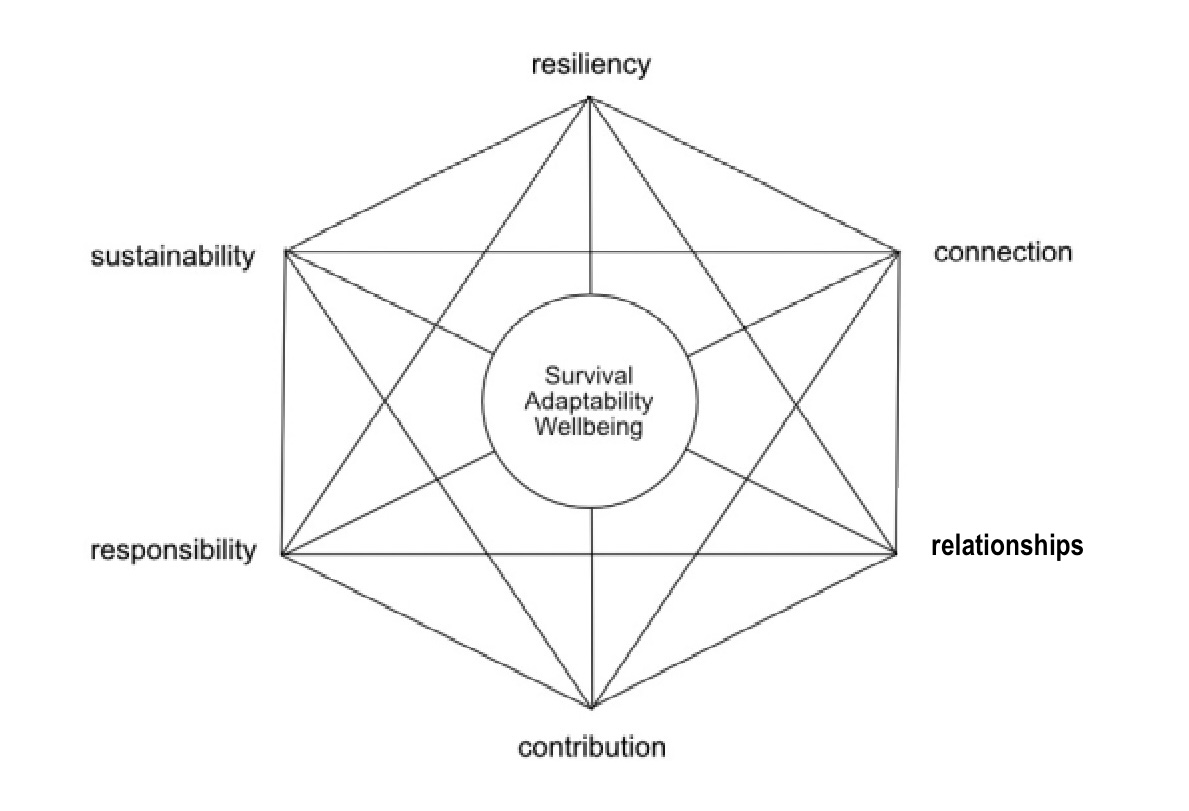
These six values shown in the hexagram represent some of the defining values of the interdependent worldview. The full contribution of these values to a sustainable and compassionate society results from the natural interaction of several or all of values in a given situation. Relationships between values add multiple perspectives and meanings. However, any of them may be a dominant influence in specific circumstances.
Sustainability:
Examples of sustainability initiatives include energy efficiency (e.g., LED lighting, smart sensors), waste reduction (e.g., recycling, composting, going paperless), sustainable transport (e.g., promoting public transit, cycling, and EV incentives), and supply chain management (e.g., partnering with green suppliers, local sourcing). Other examples include water conservation, renewable energy use, and employee education and engagement programs. Systems are sustainable when they conform to the realities of interdependent existence.
Resiliency:
Examples of resilience in everyday life include a child getting back on a bike after falling, an employee taking initiative after being laid off, or someone reframing a project setback as a learning opportunity. It also includes managing emotions, problem-solving when faced with unexpected issues, and adapting to changing circumstances rather than giving up. Our interdependent relationships are the basis of our resilience.
Connection:
A phone charging a device is a simple example of a physical connection, while a scientist finding a link between air pollution and asthma demonstrates a causal connection. Other examples include the emotional connection between people, the link between two separate subway routes for a transfer, or an internet connection allowing devices to communicate. Ultimately all things are connected since everything exists through interdependent interactions. This is most easily recognized in living things such as a rose blossom, or a butterfly.
Responsibility:
Personal responsibility is the willingness to accept the consequences of one’s own actions and decisions, and the duty to make one’s life worthwhile and be fair to others. It involves being accountable for successes and failures, making constructive choices, and avoiding blaming external factors for shortcomings. Key aspects include self-awareness, integrity, and the understanding that personal choices have consequences in an interdependent world.
Interdependent Relationships:
An interdependent relationship is a healthy dynamic where partners support each other while maintaining their individual identities. Key characteristics include mutual reliance, clear boundaries, open communication, and shared responsibility, which allows both partners to grow personally and feel secure in the relationship. Ultimately, all things exist in and as vast webs of interdependent relationships.
Contribution:
A personal contribution is what you give or do to help a cause, project, or group effort. It can take many forms, including your time, effort, skills, or financial resources. It reflects your unique abilities and commitment to making a difference.
Conclusion:
Unlike the values of the independent worldview we have been operating under the values of the interdependent worldview are based on a fact of nature (interdependent existence) and as such are not arbitrary or negotiable. They are moral imperatives that we must follow if we are to survive as a species. To ignore them as we have been is like trying to live without oxygen. It cannot be done for long.
The values of the interdependent worldview represent a prescription for what ails us as a species. Now is the time for us all to act according to their guidance.