
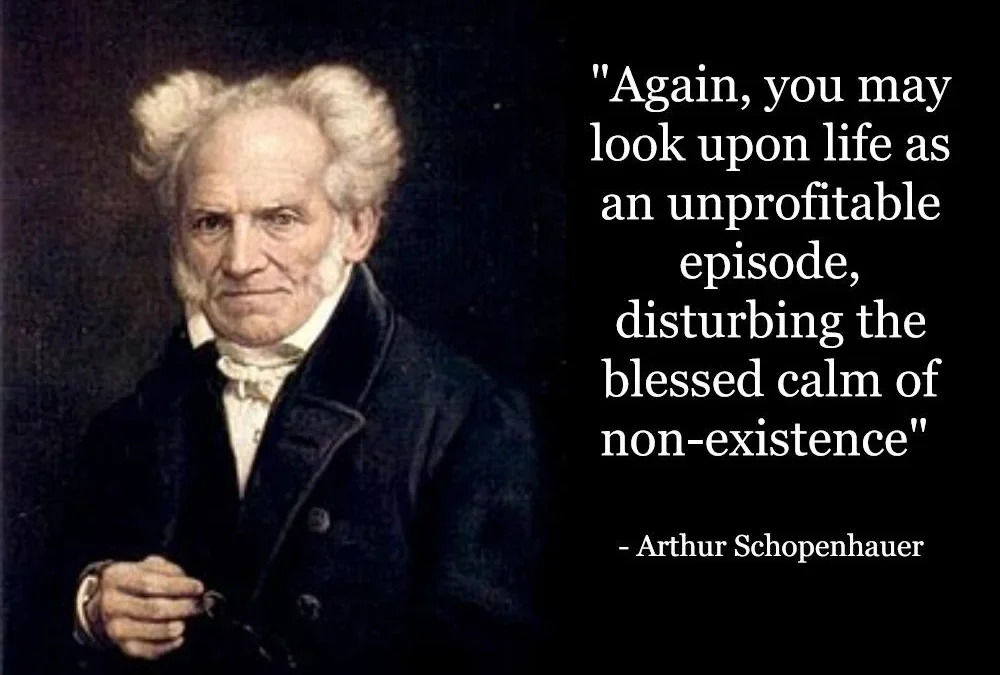
German philosopher Arthur Schopenhauer claimed that human suffering was due to desire and that desires stem from the desire to live. Because of its instinctive nature this will to live was believed by Schopenhauer to cause us blindly obey its urgings. He did not believe in free will. His views are sometimes characterized as philosophical pessimism. The portrait above painted in 1859 seems to support that opinion as does the grumpy quotation.
All life forms have needs that must be met and therefore must have some kind of ‘desire’ that drives them to meet those needs. In primitive life forms this ‘desire’ is not a conscious experience. It is in the form of a simple stimulus/response mechanism whereby an organism acquires crucial life-supporting substances from its environment. For living things meeting their needs is not optional, it’s literally a matter of life and death. We too must meet our survival needs but how we go about it is more complicated and, as we will see, the real root of unnecessary suffering.
Humans have a highly developed capacity to reflect on existence, to formulate theories about how things are and how they got to be that way. Beliefs regarding these questions determine how humans attempt to meet their survival needs.
Beliefs about the nature of existence tend to fall into two main camps. The first is the assumption that people and things exist independently of each other. The second type is based on the observable realization that we and seemingly separate things actually exist interdependently.
These two mutually exclusive worldviews result in fundamentally different societies because each promotes meeting our survival needs in different ways. The worldview that assumes the existence of separate independent organisms and objects leads to societies that value things like protective borders, resource accumulation, exclusive groups, control, personal status, and dominance over others.
In contrast, the worldview that sees people and things existing interdependently promotes a society that values such things as resilience, sustainability, inclusive groups, personal responsibility, humility, and contribution.
Our values govern the ways in which we attempt to meet our survival needs.
Up to and including the present century Western Civilization has been dominated by the independent worldview. Individuals have sought to meet their survival needs in ways that align with the values of this mindset.
In this view individuals attempt to be as self-sufficient as possible. This is an insecure and fearful way to live. It leaves it up to each independent individual to look out for themselves and their loved ones. Disaster lurks just around the corner. Life is unpredictable and often lonely. As seemingly independent beings people are vulnerable to all manor of misfortune. To survive they strive to look out for number one, be suspicious of others, and exercise power over others.
To meet their need for secure access to resources they favour personal or in-group accumulation of scarce resources. This tends to lead to greed. The need for safety is enforced by strict rules and strong boundaries leading to division, mistrust, and conflict. It is believed that without the rule of some ultimate authority humankind will descend into some kind of dog-eat-dog approach to meeting their needs.
And so it is with all attempts to meet the survival needs of humans who believe themselves to be independently existing individuals.
Based on the way living things exist in nature the interdependent worldview fosters a society of individuals who openly depend on each other and sustainable practices in seeking to meet their needs. There is a feeling of togetherness, mutual respect, and a willingness to cooperate with others. Individuals understand their essential dependence on each other and a healthy environment and the role they play in keeping it healthy.
Schopenhauer’s claim that suffering was caused by desire and that the will to live can drive us to do things that result in suffering was not wrong. What was erroneous was the assumption that we are doomed to live this way. It is not the will to live itself that is the cause of suffering. It is the ways in which we attempt to meet our survival needs that can result in suffering. And the ways we attempt to meet our needs depends on whether we see ourselves as independent or interdependent beings.
Living as if we are independent individuals guarantees unnecessary suffering because the ways we go about meeting our needs will be based on a faulty assumption about the nature of existence.
Conversely, living a life based on an understanding of the interdependent nature of existence will ensure that we engage in ways of meeting our needs that are in line with the values inherent in that understanding.
Judging by the state of the world today with its violent conflicts, climate change, gross economic disparity, and social injustice, Schopenhauer’s Error is still being committed by too many of us. This is especially true of corporate leaders and politicians responsible for making decisions that continue to perpetuate the problematic effects of the belief in independently existing living things.