
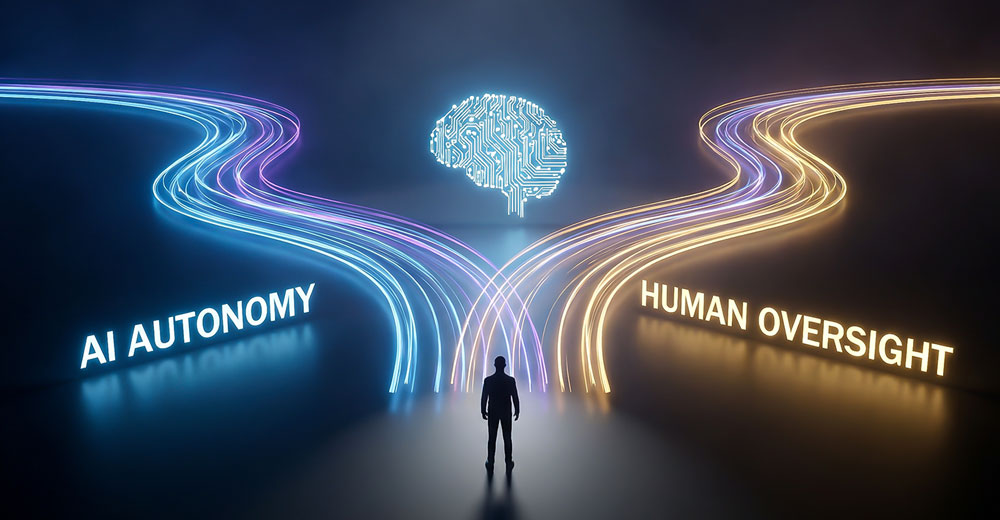
There is a lot of discussion these days about AI alignment. Generally speaking, AI alignment is about instilling some kind of conscience in AI agents so they don’t take over the world and kill us all. While the possibility of an AI Armageddon may sound like media hype some leaders in the artificial intelligence business are quite serious about it. Nobel prize winner (also known as the godfather of AI), Geoffrey Hinton says there is a 10 – 15% chance it could happen.
That’s a chance nobody wants to take. This is why the developers of AI are talking about AI alignment.
A major movement in rooting out bias, then, is trying to better expose, and better understand, the training datasets behind major academic and commercial machine-learning systems.
Christian, Brian (2020). The Alignment Problem: Machine Learning and Human Values (Function). Kindle Edition.
Anthropic AI has been holding meetings with spiritual leaders of a variety of religious and philosophical stripes in hopes of coming up with some set of universal moral tenets that might somehow act as moral guidance for AI agents. To me this seems like an impossible task. Ever since the so-called death of God there has been a string of unsuccessful attempts to replace divine authority with some kind of human designed moral code to which most people could agree. But where do you find a replacement for the infallible authority of a deity?
Bias in machine-learning systems is often a direct result of the data on which the systems are trained—making it incredibly important to understand who is represented in those datasets, and to what degree, before using them to train systems that will affect real people.
Christian, Brian (2020). The Alignment Problem: Machine Learning and Human Values (Function). Kindle Edition.
I agree with this statement by Brian Christian but I think it is missing an important point. The reason it is “incredibly important to understand who is represented in those datasets” is because it is the values of those who are represented that will be picked up by the AI agents being trained on those datasets. And this is where the unrecognized problem arises. The common cultural values of those represented will determine the values with which the AI’s will formulate their responses. Since the values of our culture are the problematic values of the erroneous independent mindset, current AI responses will continue to perpetuate those troublesome values.
But it gets worse. The training data used to give AIs a basis for making judgements is weighted according to what the designers consider to be important. It is almost certain that those responsible for weighting the data will do so according to what they consider to be the common values of our culture, in other words, the values of the independent mindset. Thus the weightings of the training datasets will reinforce the values already in the data, that of those represented in the datasets.
What all of this comes down to is that even if the AI developers succeed in giving their systems consciences the values of the independent mindset will still be dominating our culture. AI alignment is an admirable goal but it needs to be founded on values related to the actual nature of existence.
And yet a golden opportunity stands before us. If somehow, the developers of AI systems could come to understand that the global issues we face are largely due to the values inherent in the erroneous assumption of separate independent existence, they might then see the potential of the interdependent mindset to rectify some of the damage done by a belief in independent existence. Furthermore, they might also see how the nature-based values of the interdependent mindset could provide reliable guidance in creating a better future.
AIs trained on the values of the interdependent mindset might just be the agents of change needed to accelerate a shift from a culture based on a mistaken assumption about reality to one grounded in the true nature of existence. Now that’s an alignment worth hoping for.